
If someone tells you that investing in the stock market means constantly tracking the news, studying company balance sheets, and trying to pick the next winning stock, they're only telling you half the story. The other half is that you don't have to do any of that to start investing.
Today, many Indian investors are choosing a much simpler approach by investing in index funds.
Instead of trying to beat the market, index fund investing is based on a simple idea of owning the market itself.
Whether you're investing ₹500 a month through a SIP or building a long-term retirement portfolio, understanding what index funds are and how they work can help you make more confident investment decisions.
In this guide, we'll cover everything you need to know about index funds in India, including how they work, their benefits and limitations, and how you can start investing as a beginner.
Let's start with the basics.

What are Index funds?
Imagine you want to invest in India's biggest companies, but you don't know which stocks to buy. Should you invest in Reliance? TCS? HDFC Bank? Infosys? And what percentage should you invest in each?
Researching dozens of companies can quickly become overwhelming, especially if you're just starting your investing journey. This is where index funds come in.
An index fund is a type of mutual fund that automatically invests in a group of companies that make up a market index, such as the Nifty 50 or the Sensex. Instead of trying to pick the best-performing stocks, it simply aims to mirror the performance of the index it tracks.
Think of an index as a ready-made basket of companies.
For example, the Nifty 50 represents 50 of the largest companies listed on the National Stock Exchange (NSE), while the Sensex tracks 30 well-established companies listed on the Bombay Stock Exchange (BSE).
If you'd like to understand how the Nifty 50 is constructed and periodically rebalanced, the NSE Indices methodology explains the eligibility criteria and index maintenance process.
When you invest in a Nifty 50 index fund, your money is automatically spread across those 50 companies in almost the same proportion as the index. As the index changes over time, the fund updates its holdings to continue tracking it.
Unlike actively managed mutual funds, the fund manager isn't trying to outperform the market by selecting stocks. Their job is simply to replicate the chosen index as closely as possible. That's why index mutual funds in India are known as passively managed funds.
If you're new to mutual funds, AMFI's investor education resources provide a simple introduction to how different types of mutual funds work.
How do index funds work?
Now that you know what an index fund is, let's see what happens after you invest in one.
When you invest in an index fund, your money is pooled with investments from thousands of other investors. The fund then uses this money to buy the same companies that make up its underlying index, in nearly the same proportion.
Suppose you invest ₹10,000 in a Nifty 50 index fund. If Reliance Industries makes up 10% of the index, around ₹1,000 of your investment is allocated to Reliance. If TCS represents 5%, about ₹500 goes into TCS, and so on for all the companies in the index. As the index changes over time, the fund adjusts these allocations automatically.
For instance, when Reliance is removed and HDFC is added, the fund automatically updates its portfolio to continue tracking the index.
Since the fund manager isn't actively researching stocks or trying to beat the market, there is relatively little buying and selling. This passive approach keeps operating costs low, which is one of the biggest advantages of index fund investing.
That being said, an index fund's returns are rarely identical to the index it tracks. A small difference, known as tracking error, can occur due to factors such as fund expenses, transaction costs, and temporary cash holdings. In general, a lower tracking error indicates that the fund is doing a better job of mirroring its benchmark.
Let’s understand what are the types of Index funds in India.
Types of index funds in India
When people think of index funds, the Nifty 50 Index Fund is usually the first one that comes to mind. However, it's not the only option available.
In India, index funds are designed to track different market indices, giving investors the flexibility to choose based on their investment goals and risk appetite.
Here are some of the most common types of index funds:
Nifty 50 Index Funds
These track the Nifty 50 Index, which consists of India's 50 largest listed companies across various sectors. Because of their broad diversification and relatively lower volatility compared to mid and small cap funds, they're often the preferred choice for beginners.
Sensex Index Funds
These mirror the Bombay Stock Exchange (BSE) Sensex, an index of 30 well-established companies listed on the BSE. While they track fewer companies than the Nifty 50, they still provide exposure to many of India's largest businesses.
Nifty Next 50 Index Funds
These track the 50 companies that rank just below the Nifty 50 in terms of market capitalization. Since many of these companies are still growing, they can offer higher growth potential but also come with greater volatility.
Mid-cap and Small-cap Index Funds
Instead of focusing on large companies, these funds track indices made up of medium-sized or smaller businesses. While they may generate higher returns over the long term, they're generally more volatile and better suited for investors with a higher risk tolerance.
Sectoral Index Funds
These funds track a specific sector or industry, such as banking, information technology, healthcare, or pharmaceuticals. Since your investment is concentrated in a single sector, they tend to carry higher risk than diversified index funds.
For most first-time investors, starting with a broadly diversified fund like a Nifty 50 Index Fund is often a simpler choice than investing in sector-specific or mid- and small-cap index funds. As you gain experience and your investment goals evolve, you can explore other types of index funds based on your risk appetite and portfolio strategy.
Benefits of investing in index funds in India
Let's look at why Index funds have become one of the most popular investment options for both beginners and experienced investors.
1. Lower investment costs
Unlike actively managed mutual funds, index funds don't require fund managers to constantly research companies or buy and sell stocks in an attempt to beat the market.
Since they're passively managed, they usually have a lower expense ratio. While the difference may seem small, lower costs mean more of your money stays invested, which can make a meaningful difference over the long term.
2. Instant diversification
Building a diversified portfolio by buying individual stocks can be expensive and time-consuming. With a single index fund, you get exposure to dozens of companies across different sectors. This means your investment isn't dependent on the performance of just one company, helping reduce company-specific risk.
3. No need to pick winning stocks
One of the biggest challenges for investors is deciding which stocks to buy and when to buy or sell them. Index funds eliminate this guesswork. Instead of trying to identify tomorrow's winners, you simply invest in the market itself and aim to earn returns that closely match the index.
4. Ideal for long-term investing
Stock markets can be volatile in the short term, but over longer periods, they have historically rewarded patient investors. Index funds allow you to participate in India's long-term economic growth without having to actively monitor your portfolio or react to daily market movements.
5. Beginner-friendly
If you're new to investing, index funds are one of the easiest ways to get started. You don't need to analyse company financials, track market news every day, or compare hundreds of mutual funds. A broad-market index fund, such as a Nifty 50 Index Fund, offers a simple and disciplined way to start your investment journey, which is why it's often considered one of the best index funds for beginners in India.
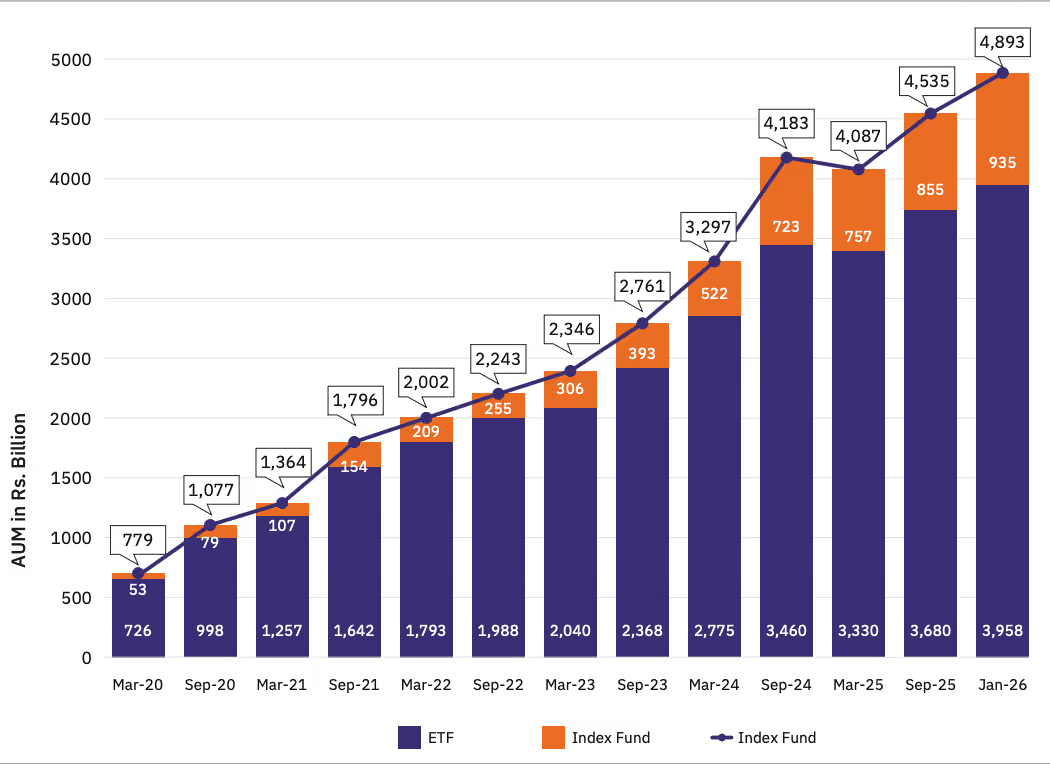
The increasing popularity of passive investing in India is also reflected in the steady growth of assets managed by index funds and ETFs, according to the NSE Indices Nifty 50 Whitepaper (2026).
Pros and cons of index funds
Like any investment, index funds come with both advantages and limitations. While they're known for being low-cost and easy to invest in, they're not the right choice for every investor. Understanding both sides can help you decide whether index funds align with your financial goals and risk tolerance.
None of these disadvantages necessarily make index funds a poor investment. In fact, most are simply a result of how index funds are designed to work.
If the market performs well over the long term, an index fund aims to grow along with it. Likewise, when the market falls, your investment will also decline because the fund is built to mirror the index rather than avoid market downturns.
That's why index funds are best suited for investors who have a long-term investment horizon and are comfortable riding through short-term market fluctuations.
Are index funds safe in India?
After learning that index funds move with the market, it's natural to wonder whether they're actually a safe investment.
The answer is yes, but with a few important caveats.
Compared to investing in individual stocks, index funds are generally considered less risky because your money is spread across multiple companies rather than being concentrated in just one. Even if one company underperforms, its impact on your overall investment is usually limited.
However, index funds are still equity investments, which means they're not immune to market volatility. If the overall stock market falls, the value of your index fund investment is also likely to decline in the short term.
This is why index funds are better suited for long-term investors rather than those looking for quick or guaranteed returns. Giving your investments at least five years allows you to ride out short-term market fluctuations and benefit from the market's long-term growth potential.
The key takeaway is, index funds reduce company-specific risk, but they don't eliminate market risk. Understanding this distinction can help you set realistic expectations before you invest.
SEBI also encourages investors to understand the risks associated with equity investing before making investment decisions and provides educational material for first-time investors.
ETF vs index funds: What's the difference?
Once you start researching index funds, you'll often come across another investment option called an Exchange Traded Fund (ETF). Since both are designed to track a market index, it's easy to assume they're the same.
While they share the same objective, the biggest difference is how you invest in them.
An index fund is purchased directly from a mutual fund house or an investment platform, whereas an ETF is bought and sold on a stock exchange, just like individual shares.
Here's a quick comparison:
For most beginners, index mutual funds are usually the easier option because they don't require a demat account and make SIP investing simple. ETFs, on the other hand, may be a better fit for investors who already have a trading account and prefer the flexibility of buying and selling during market hours.
Ultimately, both can help you invest in the same underlying index, the choice depends on how you prefer to invest. Here’s yet another comparison to help beginners clear the air.
Index Funds vs Active Mutual Funds
A common question among beginners is whether index funds are better than actively managed mutual funds. The answer depends on your investment style and expectations.
Index funds follow a passive investing approach. Instead of trying to outperform the market, they simply track a benchmark index like the Nifty 50 or Sensex. As a result, they usually have lower costs and require very little intervention from the fund manager.
Active mutual funds, on the other hand, are managed by professional fund managers who research companies and actively buy or sell stocks with the goal of generating returns that beat the market. While this creates the potential for higher returns, it also comes with higher costs and no guarantee of outperforming the benchmark.
What are the best index funds in India?
Once you've decided that index funds are right for you, the next obvious question is: Which one should you invest in?
The truth is, there isn't a single "best" index fund for everyone. The right choice depends on the index you want to track and the fund's ability to closely mirror that index over the long term.
Instead of choosing a fund based only on its recent returns, consider factors such as:
- Expense ratio: Lower costs mean more of your money remains invested.
- Tracking error: A lower tracking error indicates that the fund is doing a better job of replicating its benchmark.
- Assets under management (AUM): Larger funds often have better liquidity, although size shouldn't be the only deciding factor.
- Fund house reputation: Choosing a well-established asset management company can provide greater confidence in the fund's management.
- Benchmark index: Decide whether you want exposure to the Nifty 50, Sensex, Nifty Next 50, or another market index.
Some of the popular index funds in India include:
- UTI Nifty 50 Index Fund
- HDFC Index Fund: Nifty 50 Plan
- ICICI Prudential Nifty 50 Index Fund
- SBI Nifty Index Fund
- Nippon India Nifty 50 Index Fund
Rather than looking for the "best" index fund based solely on recent returns, compare funds tracking the same benchmark using metrics like expense ratio, tracking error, and consistency. For most long-term investors, consistency matters far more than short-term performance.
Note: The funds listed above are examples and not recommendations. Always compare funds based on expense ratio, tracking error, benchmark, and your own financial goals before investing.
If you are looking to understand how to start investing in Index funds, read here.

Frequently Asked Questions on Index funds
1. Are index funds better than mutual funds?
Index funds are a type of mutual fund, so the comparison is usually between index funds and actively managed mutual funds. Index funds aim to match the market's performance at a lower cost, while actively managed funds try to outperform the market by selecting stocks. The right choice depends on your investment goals, risk tolerance, and investing style.
2. Can beginners invest in index funds?
Yes. In fact, index funds are often considered one of the best investment options for beginners. They offer instant diversification, have relatively low costs, and don't require you to research or select individual stocks. This makes them a simple way to start investing in the stock market.
3. Who should invest in index funds?
Index funds can be a good choice for a wide range of investors, especially if you're looking for a simple and disciplined way to build long-term wealth.
They may be suitable if you:
- You're a beginner investor looking to get started in the stock market.
- You prefer a simple investment strategy over researching individual stocks.
- Your goal is long-term wealth creation through regular investing.
- You don't have the time or interest to actively track the stock market.
- You invest through a Systematic Investment Plan (SIP) and want a low-maintenance portfolio.
While index funds suit many investors, it's still important to choose a fund that aligns with your financial goals, investment horizon, and risk tolerance.
4. How much should I invest in an index fund?
There's no fixed amount you need to invest. Many fund houses allow you to start a SIP with as little as ₹500 per month. Instead of focusing on a specific amount, invest an amount that comfortably fits your budget and aligns with your financial goals.
5. Can index funds lose money?
Yes. Since index funds invest in the stock market, their value can decline when the overall market falls. However, these fluctuations are a normal part of equity investing. Investors with a long-term horizon often stay invested through market ups and downs, giving their investments time to recover and grow over the years.
6. What are the common mistakes beginners make while investing in index funds?
While index funds are simple to understand, new investors can still make a few common mistakes that may affect their long-term returns. Some of the most common ones include:
- Choosing a fund based only on recent returns: Past performance doesn't guarantee future returns. Instead, compare funds tracking the same index over longer periods.
- Ignoring the expense ratio: Even a small difference in costs can have a significant impact on your returns over the long term.
- Overlooking tracking error: A lower tracking error indicates that the fund is more closely replicating its benchmark index.
- Stopping SIPs during market downturns: Market corrections are a normal part of investing. Continuing your SIP during volatile periods can help you benefit from rupee cost averaging.
- Expecting guaranteed returns: Index funds invest in the stock market, so returns are not guaranteed. They are generally better suited for long-term investors who can tolerate short-term market fluctuations.
Avoiding these common mistakes can help you get the most out of index fund investing and stay focused on your long-term financial goals.
Disclaimer : This article is for educational purposes only and does not constitute investment advice. Investments in securities markets are subject to market risks; read all related documents carefully before investing.