
AI Investment Advisor in India: What It Can (and Can't) Do for Your Money
If you're looking for an article that promises you that the AI can predict the next multibagger stock or tell you exactly where to invest to maximize your returns this year, this isn't that article.
Over the last few years, AI has quietly become the friend we turn to, for almost everything. From planning holidays and drafting emails to preparing for interviews, settling random debates, and yes, even getting over an ex, AI has become part of our everyday lives.
Personal finance is no exception, and the rise of the AI investment advisor is one of the biggest changes we're seeing. However, relying on AI for personal finance raises an important question: Can AI actually help you make better financial decisions?
The short answer is yes. But probably not in the way most people imagine.
An AI investment advisor isn't simply a chatbot that tells you which stocks to buy or predicts the next market winner. At its best, it acts more like a personal financial guide, helping you understand your financial life, stay consistent with your goals, avoid emotional investing mistakes, and make smarter long-term decisions.
In this guide, we'll explain what an AI investment advisor actually is, how it's different from a robo advisor, where it can genuinely help, and where its limitations still exist, especially for Indian investors.
Let’s begin right with the basics.
What exactly is an AI investment advisor?
An AI investment advisor is a software platform that uses artificial intelligence to analyse your financial information and provide personalised investment guidance.
Unlike traditional investment apps that simply execute transactions, and give you widgets of data, AI advisors can understand context, answer financial questions in natural language, identify spending patterns, and recommend actions based on your goals.
For example, instead of simply showing that your SIP is ₹10,000 per month, an AI advisor may tell you:
- You're likely to fall short of your retirement goal.
- Increasing your SIP by ₹2,000 from now on could help you retire three years earlier.
- Your emergency fund is smaller than recommended.
- Your spending has increased by 18% over the last six months.
The emphasis here shifts from mere presenting financial data to helping users make better decisions.
Want to understand how AI is transforming financial services? IBM’s overview of AI in finance explains how AI is being applied across banking and personal finance.
Why are AI investment advisors becoming relevant in India?
For a long time, personalised financial advice wasn't something most Indians had access to. It was largely reserved for high-net-worth individuals, while everyone else relied on YouTube videos, blogs, WhatsApp forwards, fin-fluencers, or advice from friends and family to make important money decisions.
The challenge is that personal finance is exactly what the name suggests it to be: personal.
The right investment strategy for a 27-year-old software engineer in Bangalore could be very different from that of a 40-year-old business owner in Chennai. Income, financial goals, risk appetite, family responsibilities, and existing investments all shape what makes sense for each individual. Generic financial advice doesn't apply to everyone and this is where the youtube hacks were failing.
With AI becoming more capable and accessible, investment advice is beginning to evolve. Instead of giving everyone the same generic recommendations, AI can analyse your financial information, understand your goals, and offer guidance that's more relevant to your situation. Whether it's helping you decide how much to invest each month or checking whether your portfolio matches your risk profile, AI is making personalised financial guidance more accessible than ever.
It doesn't replace a human financial advisor, especially for complex financial decisions. But it does make quality financial guidance available to millions of Indians who previously had little or no access to it.
India has also identified artificial intelligence as a key technology for improving access to services across sectors, including financial services, through initiatives outlined by NITI Aayog.
How AI is changing personal finance in India?
The biggest change AI brings to personal finance isn't that it can analyse more data. It's that it can turn that data into actionable guidance. Traditional finance apps are great at showing numbers like your account balance, portfolio value, monthly spending, or SIP performance. But they often leave the next step up to you.
AI is changing that.
Instead of simply reporting what has already happened, AI can help users understand what those numbers mean and what they should do next.
Here are some of the ways AI is transforming personal finance.
Personalised financial guidance
Everyone's financial situation is different, so financial advice shouldn't be one-size-fits-all.
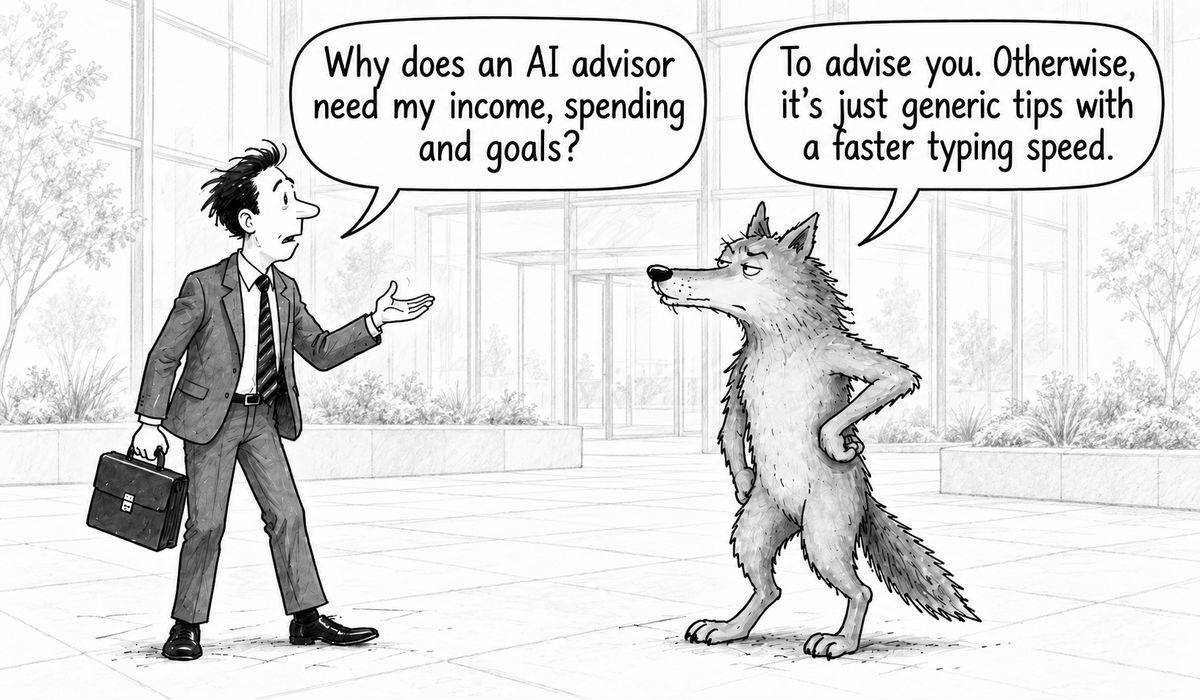
AI can analyse factors such as your income, spending habits, savings rate, existing investments, risk appetite, and financial goals to provide recommendations that are relevant to your situation instead of generic investing tips.
Goal-first investing
Instead of starting with investment products, AI starts with your goals.
Whether you're building an emergency fund, saving for a house, planning for retirement, or working towards financial independence, AI can help estimate how much you need to invest and whether you're on track to reach those milestones.
Better financial habits
One of AI's biggest strengths isn't stock selection. It can help people stay disciplined.
It can remind you when you've missed a SIP, alert you if your spending is increasing faster than your income, or encourage you to stay invested during periods of market volatility. These small nudges can often have a bigger impact on long-term wealth than trying to time the market.
.jpg)
Smarter financial planning
Many AI-powered platforms can also help users monitor their overall financial health by tracking net worth, highlighting tax-saving opportunities throughout the year, and identifying gaps in areas like emergency savings or insurance coverage.
The goal isn't to replace financial decision-making. It's to make every financial decision a little more informed.
AI investment advisor vs Robo advisor: Are they the same?
If you're wondering whether they're the same, the answer is not exactly.
Although the two terms are often used interchangeably, they solve different problems. Here’s a little snippet of what each of them can do.
A robo advisor helps manage investments. But an AI investment advisor helps manage financial decisions. Many modern platforms are beginning to combine both approaches, but AI significantly expands what users can expect beyond portfolio allocation.
What can an AI investment advisor help you with?
Once you start looking at an AI investment advisor as a financial co-pilot rather than a tool that simply recommends investments, its real value becomes much clearer.
Depending on the platform, it can help answer many of the financial questions people ask themselves every month, such as:
- Am I investing enough to reach my financial goals?
- How much should I increase my SIP after this salary hike?
- Is my current portfolio aligned with my risk appetite?
- Am I saving enough for retirement?
- How is my overall net worth growing over time?
- Am I spending more than I should?
- What can I do to improve my monthly savings?
- Are there any tax-saving opportunities I'm missing?
- Am I on track to buy a house before 35?
Many AI-powered platforms also bring together your bank accounts, investments, loans, and other financial information into a single view, making it easier to understand your overall financial health instead of analysing each account separately.
Perhaps the biggest advantage of an AI investment advisor is accessibility.
Traditional financial advice often requires booking appointments or meeting minimum investment thresholds. AI makes financial guidance available whenever you need it. Whether you have a quick question about your portfolio or want to understand how a financial decision could affect your long-term goals, you can get personalized guidance within seconds.
What AI investment advisors cannot do
Despite rapid advancements, AI isn't a replacement for professional financial advice in every situation. Many people search for an AI stock advisor that can consistently pick winning stocks. Unfortunately, no AI can reliably predict future market movements. While it can help you make smarter financial decisions, here are few things you shouldn’t rely on AI for:
Predict stock market movements
No AI can consistently predict short-term market movements or identify the next multibagger stock with certainty. If a platform promises guaranteed stock picks or market-beating predictions, it's worth approaching those claims with caution.
.jpg)
Guarantee investment returns
AI can analyse historical data and identify patterns, but it cannot guarantee returns. Financial markets are influenced by economic conditions, global events, investor sentiment, and countless unpredictable factors. Every investment carries some level of risk.
SEBI also reminds investors that no platform or technology can guarantee investment returns, and investors should always understand the risks before investing. Also, review SEBI’s tips on spotting any scam before investing into a fund.
Replace human judgement in complex situations
AI can assist with everyday financial planning, but it isn't a substitute for professional advice in complex situations. Decisions involving business ownership, inheritance, cross-border taxation, divorce settlements, or advanced estate planning are best handled with the guidance of an experienced financial advisor.
Eliminate investment risk
AI can help you make better-informed decisions, but it cannot remove market volatility or investment risk. The goal of an AI investment advisor isn't to eliminate uncertainty. It's to help you navigate it with greater confidence. Ultimately, the best way to think about an AI investment advisor is as a decision-support system, not a crystal ball.
How to choose the right AI investment advisor in India?
As AI becomes the latest buzzword in personal finance, almost every platform claims to offer AI-powered insights for financial guidance. But not every AI investment advisor delivers meaningful value. When evaluating a platform, here are a few questions worth asking.
Does it understand your financial goals?
A good AI investment advisor starts with why you're investing. Whether you're saving for a house, retirement, or financial independence, its recommendations should be aligned with your goals rather than simply suggesting investment products.
Does it offer personalised guidance?
The best AI advisors don't provide one-size-fits-all advice. They consider factors such as your income, existing investments, risk appetite, spending habits, and financial goals before making recommendations.
Can it see your complete financial picture?
Investment advice is only as good as the information behind it. Look for platforms that bring together your bank accounts, investments, loans, insurance, and net worth so the AI has a complete understanding of your finances. In India, many financial platforms are adopting the Account Aggregator (AA) framework, regulated by the Reserve Bank of India, which enables users to securely share their financial data with their explicit consent.
Does it help you build better financial habits?
Good investing isn't just about choosing the right mutual fund or stock. Consistency matters even more. Features like reminders, progress tracking, behavioural nudges, and goal monitoring can help you stay disciplined over the long term.
Is your financial data secure?
Before connecting your bank accounts or investment portfolio, it's worth asking how the platform handles your financial data. Look for strong security practices, transparent privacy policies, and secure frameworks such as India's Account Aggregator ecosystem. After all, convenience should never come at the cost of trust.
Ultimately, the best AI investment advisor isn't the one with the longest feature list. It's the one that helps you make smarter financial decisions while giving you greater clarity, confidence, and peace of mind.
The future of AI in personal finance
Personal finance is evolving from tracking money to understanding it.
The first generation of finance apps helped users answer a simple question: "Where did my money go?"
The next generation will focus on a much more important one: "What should I do next?"
Instead of simply displaying charts, reports, and investment performance, AI-powered platforms will increasingly act as personal financial companions. They'll help users make informed decisions throughout their financial journey by answering questions like:
- Can I comfortably increase my SIP after my next appraisal?
- Am I financially ready to buy a house?
- Is my current savings rate enough to achieve financial independence?
- How much should I invest for retirement?
- Which financial goal should I prioritise right now?
As AI continues to evolve, the focus will shift from providing financial information to delivering personalised financial guidance.
For a country like India where access to qualified financial advisors is still limited for many people, AI has the potential to democratise financial advice, making it more affordable, accessible, and available whenever people need it.
The future of personal finance isn't just about smarter apps. It's about giving every individual the confidence to make better financial decisions.
Frequently Asked Questions on AI investment advisor
1. Can AI replace a human financial advisor?
No. An AI investment advisor can help with budgeting, investment planning, goal tracking, and personalised financial guidance, but it cannot replace a qualified financial advisor for complex situations such as estate planning, business finances, taxation, or inheritance planning.
2. Who should use an AI investment advisor?
An AI investment advisor can be useful for anyone looking for personalised financial guidance without hiring a full-time financial advisor. It's particularly helpful for:
- Beginners starting their investment journey with SIPs or mutual funds
- Young professionals planning for retirement or financial independence
- People managing multiple bank accounts, investments, and financial goals
- Investors working towards FIRE (Financial Independence, Retire Early)
- Anyone looking for ongoing financial guidance instead of generic stock tips
3. Which is the best AI investment advisor in India?
The best AI investment advisor depends on your financial goals and investing style. Look for a platform that offers personalised guidance, goal-based planning, net worth tracking, behavioural coaching, and secure account aggregation instead of simply recommending investment products.
4. Are AI investment advisors safe to use?
Most reputable AI investment advisors use strong encryption, secure infrastructure, and regulated financial integrations. Before connecting your accounts, always review the platform's privacy policy, security practices, and data-sharing practices to ensure your financial information is protected.
5. Can AI help beginners invest?
Yes. AI can be particularly useful for beginners by helping them understand how much to invest, set financial goals, track their progress, and avoid common investing mistakes. However, AI should support your decisions rather than replace your own judgement.
6. Can AI predict the stock market?
No. Despite advances in artificial intelligence, no AI investment advisor or AI stock advisor can consistently predict future stock market movements or guarantee investment returns. Any platform making such claims should be treated with caution.
7. Can AI help me achieve FIRE (Financial Independence, Retire Early)?
AI can help estimate how much you need to invest, monitor your savings rate, track your net worth, and assess whether you're on track to achieve financial independence. However, reaching FIRE still depends on disciplined investing, consistent saving, and long-term financial planning.
Disclaimer: This article is for educational purposes only and does not constitute investment advice. Investments in securities markets are subject to market risks; read all related documents carefully before investing.