
If you've started exploring passive investing, you've probably come across the same recommendation repeatedly: invest in a Nifty 50 index fund. But if you're wondering where to begin or how to choose the right one, you've come to the right place.
Nifty 50 index funds offer a simple, low-cost way to invest in India's largest companies without trying to predict which stocks will outperform the market.
But once you're ready to invest, a new question appears. Open any investment platform, and you'll find multiple Nifty 50 index funds from UTI, SBI, HDFC, ICICI Prudential, Navi, Kotak, and several other fund houses. Since they all track the same Nifty 50 index, are they really any different? And if they are, how do you choose the right one?
The answer is that while every Nifty 50 index fund aims to replicate the same benchmark, factors like expense ratio, tracking error, assets under management (AUM), and fund management practices can create small but meaningful differences over the long term.
In this guide, we'll explain how Nifty 50 index funds work, what sets one fund apart from another, how to compare your options, and what to look for before starting a Nifty 50 SIP.
Let’s begin with the basics - what are Nifty 50 index funds?
What are Nifty 50 index funds?
A Nifty 50 index fund is a type of mutual fund that invests in the same 50 companies that make up the Nifty 50 index, maintaining the same weight for each stock. Instead of trying to outperform the market by selecting individual stocks, the fund simply aims to replicate the performance of its benchmark as closely as possible.This approach is known as passive investing.
Rather than relying on a fund manager to identify winning stocks or time the market, a Nifty 50 index fund follows a predefined index and lets investors participate in the performance of India's largest listed companies.
Since these funds don't require extensive research or frequent portfolio changes, they're relatively inexpensive to manage. As a result, Nifty 50 index funds typically have much lower expense ratios than actively managed large-cap mutual funds, allowing investors to keep more of their long-term returns.
If you're new to passive investing and want to understand how index funds work in greater detail, read our guide on what are index funds in India?
How do Nifty 50 index funds work?
Every fund house offering a Nifty 50 index fund follows the same objective of replicating the Nifty 50 index as closely as possible. To do this, the fund invests in the same 50 companies in the same proportions as the index. Whenever NSE indices revises the index composition or stock weights, the fund updates its portfolio to stay aligned with the benchmark.
Unlike actively managed mutual funds, there are no day-to-day investment decisions based on a fund manager's market outlook. The portfolio simply reflects the index, making the investment process transparent, disciplined, and rules-based.
The returns from a Nifty 50 index fund come from two sources: the price appreciation of the underlying stocks and the dividends they pay. Most funds aim to track the Nifty 50 TRI (Total Returns Index), which assumes that dividends are reinvested, making it a more complete measure of market performance than the price index alone.
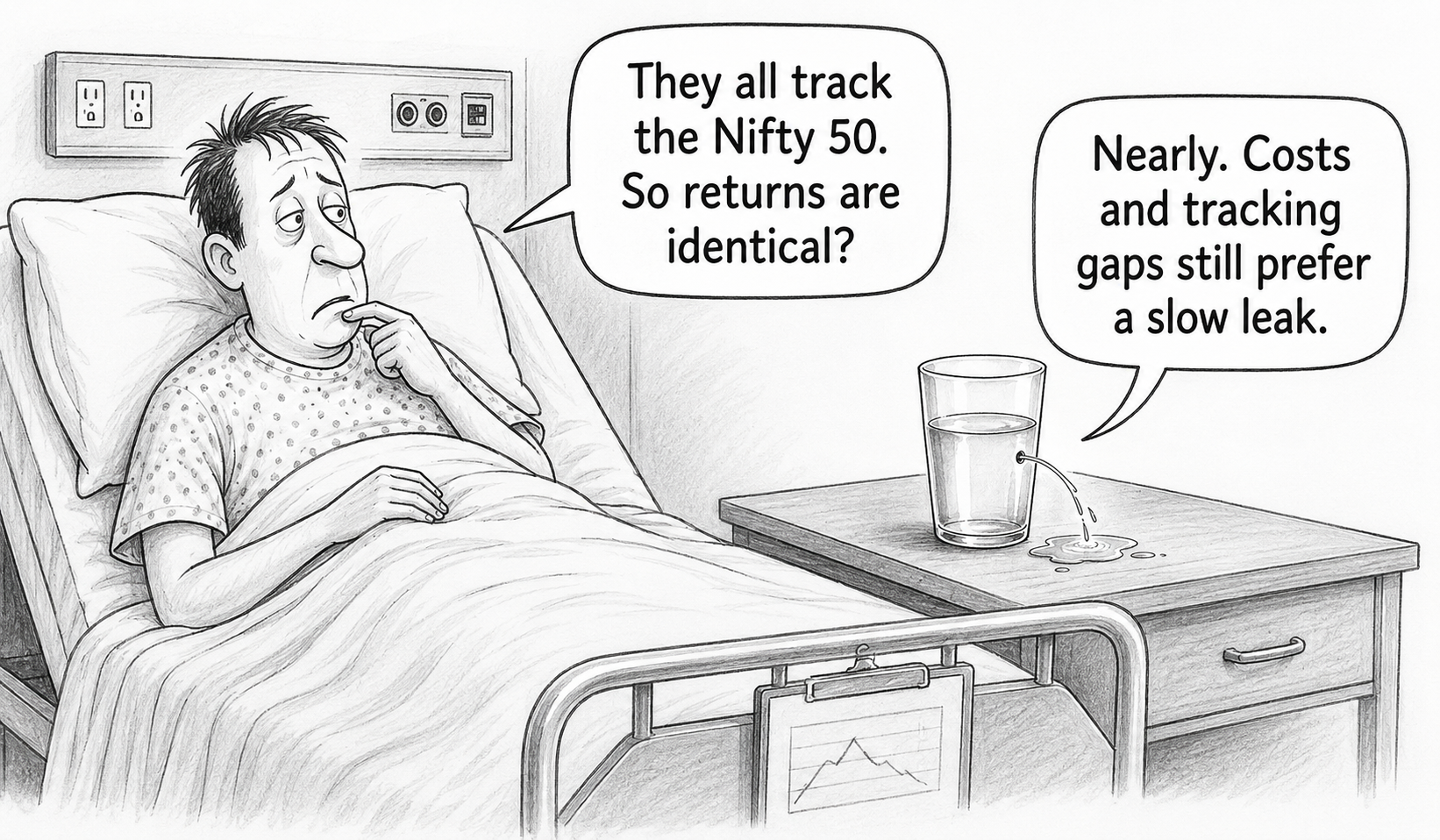
In theory, every Nifty 50 index fund should deliver almost identical returns because they're all tracking the same benchmark. In reality, however, small differences in costs, portfolio management, and execution can cause one fund to slightly outperform or underperform another over time. Understanding these differences is the key to choosing the right fund.
Are all Nifty 50 index funds the same?
Not exactly. At first glance, every Nifty 50 index fund appears identical. They all invest in the same 50 companies and aim to track the Nifty 50 TRI (Total Returns Index), which includes both stock price movements and reinvested dividends.
However, no fund can replicate the benchmark perfectly. Small operational differences can lead to slightly different returns over time.
Some of the key factors include:
- Expense ratio: Every fund charges a fee to manage your investment. Since a Nifty 50 index fund is designed to match the benchmark rather than beat it, a lower expense ratio generally helps investors retain more of the market's returns over the long term.
- Tracking error: This measures how closely a fund's returns match those of the Nifty 50 TRI. A lower tracking error indicates that the fund is doing a better job of replicating the benchmark.
- Cash holdings: Index funds may temporarily hold a small portion of their portfolio in cash to manage subscriptions, redemptions, or operational needs. During strong market rallies, this can cause the fund to slightly lag the index.
- Portfolio rebalancing: Whenever the Nifty 50 index changes its constituents or stock weights, fund managers need to rebalance their portfolios. The efficiency and timing of these trades can create small performance differences.
Individually, these differences are usually minor. But for investors making a Nifty 50 SIP over 15 or 20 years, consistently lower costs and tighter tracking can gradually add up, making it worthwhile to compare funds before investing.
How to compare Nifty 50 index funds?
When choosing a Nifty 50 index fund, it's easy to focus only on the latest returns. However, since every fund tracks the same benchmark, past returns often don't tell the full story. Instead, compare the factors that influence how closely a fund can replicate the Nifty 50 TRI over the long term.
- Expense ratio: Compare the direct growth plans rather than regular plans. Regular plans include distributor commissions, resulting in a higher expense ratio. Even a small difference in annual fees can reduce your wealth over a long investment horizon.
- Tracking error: This measures how consistently a fund's returns stay close to the benchmark. A lower tracking error indicates that the fund is more effectively replicating the index.
- Tracking difference: While tracking error measures consistency, tracking difference measures the gap between the fund's returns and the benchmark's returns. Looking at both metrics provides a more complete picture of how well a fund tracks the index.
- Assets under Management (AUM): A larger AUM can indicate that a fund is well established and may benefit from operational efficiencies. However, AUM alone shouldn't determine your choice, especially if a smaller fund has consistently demonstrated lower tracking error.
- Fund age and track record: Funds with a longer history have experienced different market cycles, allowing investors to evaluate how consistently they've tracked the benchmark over time.
- Minimum SIP amount: Most Nifty 50 SIP plans allow investments starting from ₹100 or ₹500, but the minimum amount can vary between fund houses. This is worth checking if you're just beginning your investment journey.
The best Nifty 50 index fund isn't necessarily the one with the lowest expense ratio or the largest AUM. A combination of low costs, consistently low tracking error, and reliable long-term performance is usually a better indicator of a well-managed passive fund.
Nifty 50 index fund list and comparison
Several fund houses offer Nifty 50 index funds, all aiming to replicate the performance of the same benchmark. While their portfolios are largely identical, they can differ in terms of expense ratio, tracking quality, fund size, and track record.
Note: The figures below are indicative and may change over time. Always refer to the latest fund factsheets before making an investment decision.
*Approximate values. Verify the latest figures before investing.
A few observations stand out:
- UTI and SBI have some of the largest assets under management (AUM) and have maintained relatively low tracking error over a long period.
- ICICI Prudential offers a competitive combination of cost and tracking quality.
- Navi and Bandhan are among the lower-cost options, though investors should also compare their tracking performance and operating history instead of focusing on expense ratio alone.
Ultimately, there is no single best Nifty 50 index fund for every investor. The ideal choice is one that consistently combines a low expense ratio, low tracking error, a reasonable AUM, and a proven track record. Since these metrics evolve over time, use this table as a starting point and verify the latest expense ratio, AUM, and tracking data on the respective AMC's factsheet before investing.
Nifty 50 index fund returns: What can investors expect?
A Nifty 50 index fund aims to replicate the performance of the Nifty 50 TRI (Total Returns Index), which reflects both stock price appreciation and reinvested dividends. Since these funds simply track the benchmark, their returns are expected to closely mirror the index, after accounting for the fund's expense ratio and any tracking difference.
Historically, the Nifty 50 TRI has delivered long-term annualised returns of around 10 to 12%, although returns have varied significantly across different time periods. There have been years of strong double-digit gains, as well as years when the index delivered flat or negative returns.
You can explore the historical performance and index factsheets on the NSE Indices website or download historical index data from the NSE Historical Index Data page.
The key takeaway is that Nifty 50 index funds do not offer fixed or guaranteed returns. Your actual returns will depend on:
- The overall performance of the Indian equity market.
- How long you stay invested.
- The fund's expense ratio and tracking difference.
For this reason, it's better to evaluate a Nifty 50 SIP over a horizon of 7 to 10 years or longer rather than focusing on one- or two-year returns. A longer investment period allows you to ride out market volatility and benefit from the power of compounding.
Rather than trying to predict the market's best-performing years, passive investing is about consistently participating in India's long-term economic growth while keeping investment costs low. Over decades, this disciplined approach has proven to be an effective wealth-building strategy for many investors.
SIP in Nifty 50 index funds
A Nifty 50 SIP is one of the simplest and most popular ways for investors to build long-term exposure to the Indian stock market. Instead of investing a large amount at once, you invest a fixed sum at regular intervals typically every month, to gradually accumulate units of a Nifty 50 index fund.
This approach benefits from rupee cost averaging. When markets fall, your SIP buys more units, and when markets rise, it buys fewer. While this doesn't eliminate market risk or guarantee higher returns, it helps reduce the pressure of trying to time the market and encourages disciplined, long-term investing.
Most Nifty 50 index funds allow SIPs starting from just ₹100 or ₹500 per month, making them accessible to both first-time and experienced investors. More importantly, the success of a SIP depends less on finding the "perfect" fund and more on staying invested consistently through different market cycles.
Over 10, 15, or 20 years, regular investing, compounding, and patience are often far bigger contributors to wealth creation than small differences between two well-managed Nifty 50 index funds.
Related: If you're starting your first SIP, read our guide on How to invest in index funds in India to understand how to choose a platform, complete your KYC, and begin investing.
Nifty 50 index fund vs Nifty 50 ETF
Both a Nifty 50 index fund and a Nifty 50 ETF aim to achieve the same objective: replicate the performance of the Nifty 50 index. The key difference lies not in what they invest in, but in how you buy, sell, and hold them.
For most long-term retail investors, a Nifty 50 index fund is often the more convenient choice. It doesn't require a demat account, supports automatic SIPs, and is easy to manage through any mutual fund platform.
A Nifty 50 ETF may be a better fit if you already have a demat account, want the flexibility to trade during market hours, or prefer slightly lower ongoing costs. However, ETFs can trade at a small premium or discount to their NAV, and lower trading volumes in some ETFs may affect execution prices.
If your primary goal is long-term wealth creation through regular monthly investing, a Nifty 50 index fund is generally the simpler and more hands-off option. If you value intraday trading flexibility and already invest through a brokerage account, a Nifty 50 ETF can be an equally effective alternative.
Nifty 50 index funds vs active large cap funds
Actively managed large-cap mutual funds aim to outperform the market by researching companies, selecting stocks, and adjusting their portfolios based on the fund manager's outlook. This active management comes at a cost, with expense ratios that are typically much higher than those of a Nifty 50 index fund.
The challenge is that consistently outperforming the Nifty 50 over the long term is difficult. While some active funds may beat the benchmark during certain market cycles, many find it challenging to do so consistently after accounting for management fees and other expenses. This is one of the key reasons many investors choose passive investing for their core large-cap allocation.
That doesn't mean active funds have no place in a portfolio. In market segments such as mid-cap and small-cap stocks, where there is greater variation in company quality and market information, skilled fund managers may have more opportunities to generate excess returns. Whether they succeed, however, depends on the individual fund and manager.
For investors seeking broad exposure to India's largest companies, a Nifty 50 index fund offers a simple, transparent, and low-cost way to participate in the market without relying on a fund manager's ability to consistently outperform the benchmark.
Benefits of investing in Nifty 50 index funds
A Nifty 50 index fund has become one of the most popular investment choices for long-term investors, and for good reason. Here are some of its biggest advantages:
- Instant diversification: A single investment gives you exposure to 50 of India's largest listed companies across sectors such as banking, information technology, financial services, FMCG, energy, pharmaceuticals, automobiles, and more. This reduces the risk of relying on the performance of a handful of individual stocks.
- Low investment cost: Since Nifty 50 index funds simply track a benchmark instead of actively researching and selecting stocks, they typically have much lower expense ratios than actively managed large-cap funds. Lower costs mean you get to keep more of your investment returns over time.
- Transparency: The portfolio of a Nifty 50 index fund is easy to understand because it mirrors a publicly available benchmark. Investors always know which companies they own and how those companies are weighted in the fund.
- No fund manager risk: The performance of the fund doesn't depend on a manager's ability to identify winning stocks or time the market. By following a rules-based investment strategy, passive investing removes much of the uncertainty associated with active stock selection.
- Tax efficiency: Because index funds usually have lower portfolio turnover than actively managed funds, they generally realise fewer taxable capital gains within the fund. While investors are still taxed when they redeem their units, lower trading activity can make index funds relatively tax-efficient.
- Simple long-term investing: For investors who don't have the time or interest to analyse individual companies, a Nifty 50 SIP offers a straightforward way to participate in India's long-term economic growth without constantly monitoring the markets.
This combination of diversification, low costs, transparency, and disciplined passive investing makes Nifty 50 index funds an attractive core holding for many long-term portfolios.
Risks and limitations of Nifty 50 index funds
While Nifty 50 index funds offer simplicity and low costs, they're not without risks. Understanding these limitations can help you set realistic expectations before investing.
- Market risk: A Nifty 50 index fund mirrors the performance of the market. If the Nifty 50 falls during a market correction or bear market, the value of your investment will fall as well. Unlike some actively managed funds, there's no attempt to reduce losses by moving to cash or changing stock allocations.
- Concentration risk: Although the fund invests in 50 companies, the index is weighted by market capitalisation. This means a handful of the largest companies and sectors such as financial services, information technology, and energy can account for a significant portion of the portfolio, making their performance more influential.
- No opportunity to outperform the benchmark: The objective of a Nifty 50 index fund is to match the index, not beat it. If you're looking for returns significantly above the market, passive investing isn't designed for that. At the same time, it also reduces the risk of underperformance caused by poor stock selection.
- Tracking difference and tracking error: No index fund can perfectly replicate the Nifty 50 TRI. Differences in expenses, portfolio management, cash holdings, and execution can cause a fund's returns to deviate slightly from the benchmark. Choosing a fund with consistently low tracking error can help minimise this gap.
Despite these limitations, many investors accept these trade-offs because they value the low costs, transparency, and disciplined approach that Nifty 50 index funds provide. For long-term investors, understanding these risks is often more important than trying to eliminate them altogether.
Who should consider Nifty 50 index funds?
Nifty 50 index funds tend to suit long-term investors who want equity exposure without spending time analysing individual stocks or active fund managers. They work well as a core, large-cap holding for retirement planning, long-term goals, or first-time equity investors who want a simple entry point into the market. Investors seeking short-term gains, downside protection, or the possibility of beating the market may find this category less suited to their goals.
How much should you invest in a Nifty 50 index fund?
There's no universal number. It depends on your goals, time horizon, and overall asset allocation. A common approach is to decide what proportion of your total equity allocation should go to large-cap, passive exposure, and build the rest of your portfolio around mid-cap, small-cap, or international exposure based on your risk appetite. Since a nifty 50 index fund is inherently a long-term, buy-and-hold vehicle, money you may need within the next 3 to 5 years is generally better placed in more stable instruments.
How to invest in Nifty 50 index funds
Investing in a Nifty 50 index fund is straightforward and can usually be completed in just a few steps.
- Choose an investment platform: You can invest through the fund house's official website or a trusted mutual fund investment app.
- Complete your KYC: If you're a first-time investor, you'll need to complete your Know Your Customer (KYC) verification using documents such as your PAN and Aadhaar.
- Select the Direct Plan and Growth Option: If you're investing without a distributor or advisor, choose the direct growth plan. Direct plans have lower expense ratios than regular plans because they don't include distributor commissions, allowing you to retain more of your long-term returns.
- Decide between a lump sum or a Nifty 50 SIP: If you're investing regularly from your monthly income, setting up an automatic SIP can help you build wealth in a disciplined manner without worrying about market timing.
- Stay invested for the long term: Once you've invested, avoid checking your portfolio every day. Instead, review your investments periodically such as once or twice a year, to ensure they still align with your financial goals.
If you're new to investing, our guide on how to invest in index funds in India walks you through the entire process in greater detail.
Common mistakes when choosing a Nifty 50 index fund
Since most Nifty 50 index funds invest in the same companies, the biggest mistakes often come from investor behaviour rather than the funds themselves.
- Choosing a regular plan instead of a direct plan: Regular plans include distributor commissions, resulting in higher expense ratios that can reduce your long-term returns.
- Selecting a fund based only on recent returns: A fund that topped the performance chart last year may not do so next year. Small return differences between Nifty 50 index funds are often driven by tracking differences rather than superior fund management.
- Ignoring tracking error: A low expense ratio is important, but it shouldn't be the only factor. A fund that consistently tracks the Nifty 50 TRI more closely may be a better long-term choice than one with the absolute lowest fee.
- Stopping SIPs during market corrections: Volatility is a normal part of equity investing. Pausing your Nifty 50 SIP during market declines can reduce the benefits of disciplined investing and rupee cost averaging.
- Switching funds too frequently: Moving from one Nifty 50 index fund to another to save a few basis points in expense ratio may not materially improve your returns. Frequent switching can also trigger exit loads (wherever applicable) and capital gains tax.
For most investors, choosing a well-managed fund with low costs and staying invested consistently is likely to have a far greater impact on long-term wealth creation than constantly chasing marginal differences between funds.
How CruiseMoney can help you understand your investment portfolio
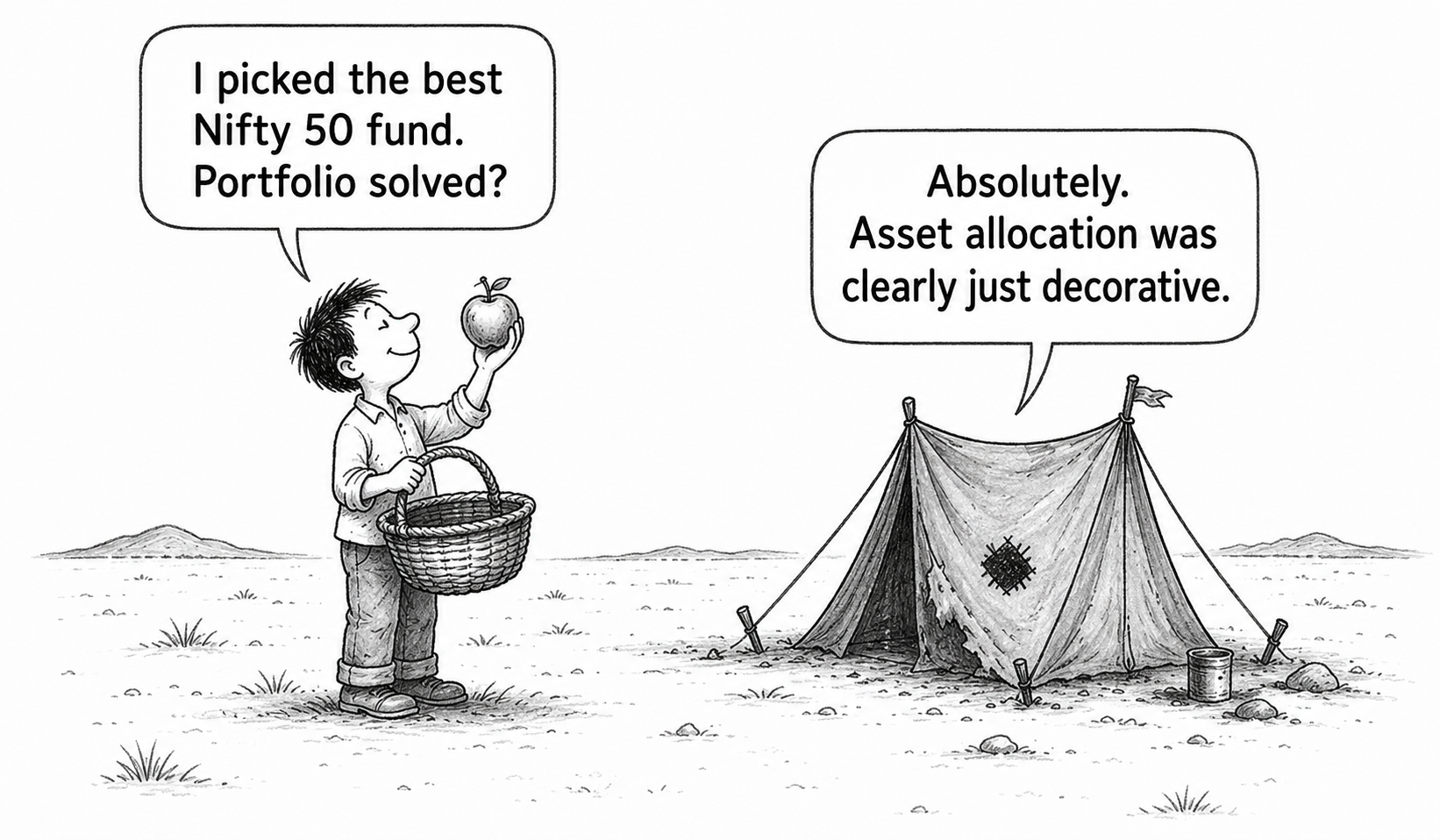
Choosing a Nifty 50 index fund is only one part of building a strong investment portfolio. Equally important is understanding how that fund fits alongside your other investments, whether they're mutual funds, stocks, debt funds, fixed deposits, or gold.
Cruise brings all your investments together in one place, helping you see the bigger picture instead of evaluating each investment in isolation. You can:
- View your overall asset allocation across equity, debt, gold, and other asset classes.
- Identify portfolio overlap between your Nifty 50 index fund and actively managed large-cap funds.
- Track your investment performance and net worth from a single dashboard.
- Understand how investment costs, including expense ratios, may affect your long-term wealth.
- Make more informed decisions based on your financial goals rather than individual fund performance.
Instead of asking, "Which is the best Nifty 50 index fund?", Cruise helps you answer a more important question: "Does this investment make my overall portfolio stronger?"
Disclaimer: This article is for educational purposes only and does not constitute investment advice. Investments in securities markets are subject to market risks; read all related documents carefully before investing.