By now, you've probably heard the same advice over and over again: "Just start investing in index funds." But once you decide to take that advice, a new set of questions appears.
Do you need a demat account? Which app should you use? How do you choose between so many index funds? Should you invest ₹500 or wait until you have more money?
If that's exactly where you are, you're not alone.
The good news is that learning how to invest in index funds in India is much simpler than most people think. You don't need to be a finance expert or spend hours tracking the stock market.
In this guide, we'll walk you through the entire process, right from completing your KYC and choosing the right platform to selecting your first index fund and starting your SIP with confidence.
Before you start: Do you need to know what an Index Fund is?
An index fund is a type of mutual fund that simply tracks a market index like the Nifty 50 or the Sensex. Instead of relying on a fund manager to pick stocks and try to beat the market, an index fund invests in the same companies that make up the index. The goal isn't to outperform the market but to mirror its performance as closely as possible while keeping costs low.
If you're completely new to the concept and want to understand how index funds work, their benefits, risks, and who they are best suited for, check out our complete guide to index funds before continuing with this step-by-step guide.
Why are index funds ideal for beginners?
For many first-time investors, the stock market feels overwhelming. There's a misconception that successful investing means spending hours analysing company financials, following business news every day, predicting market movements, and buying or selling stocks at the right time.

The truth is, you don't need to do any of that to start building wealth.
That's one of the biggest reasons why index funds have become so popular among beginners. Instead of trying to pick winning stocks or beat the market, an index fund simply tracks a market index like the Nifty 50 or Sensex. Your investment automatically gets distributed across the companies that make up that index, giving you instant diversification without having to build a portfolio yourself.
Another advantage is cost. Since index funds are passively managed, they don't require fund managers to constantly research and trade stocks. As a result, they usually have lower expense ratios than actively managed mutual funds, allowing more of your money to stay invested over the long term.
Index funds also remove a lot of the decision fatigue that comes with investing. You don't have to worry about which stock to buy next or whether it's the right time to enter the market. By investing consistently through a SIP, you can focus on building the habit of investing rather than reacting to short-term market movements.
All of these benefits naturally explain why index funds are often considered one of the best places for beginners to start investing.
The rise of index investing in India
Index investing has grown rapidly in India over the last few years as more investors have embraced low-cost, passive investing. Instead of trying to beat the market through active stock selection, many investors now prefer simply tracking broad market indices like the Nifty 50 or Sensex.
The chart below, based on data from the NSE Indices' Nifty 50 Whitepaper (2026), highlights the rapid growth of passive investing in India. It shows the steady growth in assets under management (AUM) across index funds and exchange-traded funds (ETFs). While market performance does influence AUM, the long-term upward trend also reflects increasing investor confidence and wider adoption of passive investing in India.
In a nutshell, index investing is no longer a niche strategy. As awareness of passive investing has grown, more investors have chosen index funds for their simplicity, diversification, and lower costs. Today, investors also have access to a wider range of index funds tracking different market indices, making it easier than ever to build a long-term investment portfolio.
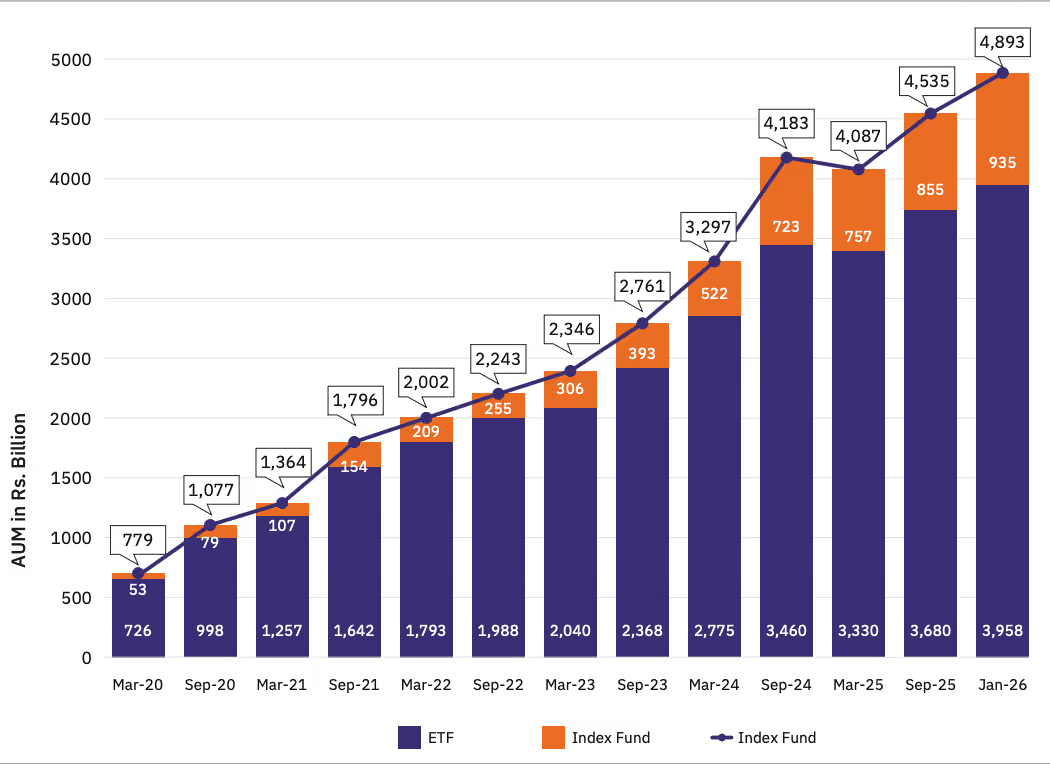
Source: NSE Indices, Nifty 50 Whitepaper (2026).
Should beginners invest in index funds?
For most people, yes.
If you're new to investing and want a simple, low-maintenance way to participate in the stock market, index funds are often a great place to begin. They offer broad market exposure, lower costs, and don't require constant monitoring, making them well-suited for long-term financial goals like retirement or wealth creation.
That said, no investment is completely risk-free. Since index funds invest in the stock market, their value can go up or down in the short term. However, investors who stay invested for the long term have historically been better positioned to ride out market volatility and benefit from compounding.
What you need before investing
The good news is that getting started with index funds doesn't involve a lot of paperwork. As long as you have a few basic documents ready, you can complete the entire process online in just a few minutes.
Before you start investing, make sure you have:
- PAN Card: Required to invest in mutual funds in India.
- Aadhaar Card: Used for identity verification and completing your KYC.
- A bank account: This is where your investment amount will be debited from and any redemption proceeds will be credited.
- A mobile number and email address: Needed for OTP verification and account-related communication.
- Completed KYC (Know Your Customer): KYC is a mandatory verification process for all mutual fund investors. Most investment platforms allow you to complete it online using your PAN and Aadhaar.
Do you need a demat account to invest in index funds?
This is one of the most common questions beginners have, and the answer depends on what you're investing in. If you're investing in index mutual funds, you do not need a demat account. You can invest directly through an AMC's website or a mutual fund investment platform after completing your KYC.
A demat account is only required if you're buying Index Exchange Traded Funds (ETFs), which are bought and sold on the stock exchange just like shares.
For most beginners, index mutual funds are usually the simpler option because you can invest through SIPs, don't need a trading account, and can start with relatively small amounts.
With these basics in place, you're ready to choose an investment platform and make your first index fund investment.
How to invest in index funds in India (Step-by-step)
Now that you have your documents ready, it's time to make your first investment. The process is much simpler than most beginners expect and can be completed in just a few minutes.
Here's how to start investing in index funds in India.
Step 1: Complete Your KYC
Before you can invest in any mutual fund, you'll need to complete your Know Your Customer (KYC) verification. This is a one-time process required by SEBI to verify your identity.
Most investment platforms will let you complete your KYC online using your PAN and Aadhaar. You'll need to verify your identity, provide your address details, and upload a few documents. Once your KYC is approved, you can invest in any mutual fund without repeating the process.
For a detailed understanding of the KYC process and regulatory requirements for mutual fund investors, you can refer to SEBI's official investor education resources.
Step 2: Decide Where You Want to Invest
Once your KYC is done, the next step is deciding where you want to invest. There are three common ways to buy index funds in India.
1. Directly through an Asset Management Company (AMC)
Every mutual fund company offers its schemes through its own website or mobile app. This is known as direct fund investing because you're investing directly with the fund house without involving a distributor. The biggest advantage is that you'll invest in Direct Plans, which have lower expense ratios than Regular Plans.
The downside is that each AMC only offers its own funds. If you want to compare schemes from multiple fund houses, you'll need to visit different websites.
2. Through mutual fund investment apps
Many investors prefer mobile app investing because it lets them access multiple AMCs in one place. These platforms make it easy to compare funds, start SIPs, track your portfolio, and manage all your investments from a single dashboard. If convenience is your priority, this can be a good option.
3. Through a stockbroker
If you already use a brokerage platform for investing in stocks, you may also be able to invest in mutual funds through the same account. This keeps all your investments in one place and can be convenient if you prefer managing everything from a single platform. The best platform is ultimately the one you're comfortable using consistently. The platform itself matters less than choosing the right fund and staying invested for the long term.
Step 3: Choose between direct and regular plans
Before investing, you'll also need to choose between a direct plan and a regular plan. While both invest in the same underlying portfolio and aim to deliver the same returns before expenses, the main difference lies in how you invest and the fees you pay.
A direct plan lets you invest directly through the fund house or a platform that offers direct mutual funds, which means there are no distributor commissions and the expense ratio is usually lower.
A regular plan, on the other hand, is purchased through a distributor or financial advisor, so it includes a commission that slightly increases the annual cost of investing.
If you're comfortable researching and managing your investments on your own, a direct plan is generally the more cost-effective option. Over the long term, even a small difference in the expense ratio can have a noticeable impact on your overall returns.
Step 4: Choose your first index fund
This is usually where beginners get stuck. If you search for "Nifty 50 Index Fund" on any investment platform, you'll probably find multiple funds from different AMCs. Since they all track the same index, it's natural to wonder which one you should choose.
Instead of focusing only on past returns, compare these factors:
- Expense ratio: This is the annual fee charged by the fund house. Lower costs mean more of your money remains invested.
- Tracking error: This measures how closely the fund follows its benchmark index. A lower tracking error generally indicates the fund is doing a better job of replicating the index.
- Assets Under Management (AUM): A larger AUM often indicates that the fund is well-established and trusted by investors, although it shouldn't be the only factor you consider.
- Benchmark index: Check which index the fund tracks, such as the Nifty 50, Sensex, or Nifty Next 50, and choose one that aligns with your investment goals.
If you're investing for the first time and don't want to overcomplicate the decision, starting with a Nifty 50 Index Fund is often the simplest choice. It gives you exposure to 50 of India's largest listed companies across different sectors, making it a well-diversified starting point for most beginners.
Step 5: Decide between a SIP and a lump sum investment
The next decision is how you'd like to invest your money. With a lump sum investment, you invest a larger amount in one go. This option may suit investors who have a significant amount available to invest immediately.
With a Systematic Investment Plan (SIP), you invest a fixed amount at regular intervals, usually every month. Your investment is automatically deducted from your bank account, making it easier to stay consistent.
For most beginners, a SIP is often the better option because it builds discipline, reduces the temptation to time the market, and allows you to invest gradually through different market conditions.
If you'd like to understand how SIPs work in greater detail, AMFI provides educational resources explaining systematic investing and its benefits.
The good news is that you don't need a large amount to begin. Many index funds allow you to start investing with ₹500, and some even accept SIPs starting from ₹100. The exact minimum investment amount depends on the fund and the platform you choose. Remember, it's always better to invest ₹500 consistently every month than to wait until you have a much larger amount.
Step 6: Complete your first investment
Once you've chosen your index fund and investment amount, the final step is straightforward. All you need to do is:
- Select the index fund you want to invest in.
- Choose whether you're making a lump sum investment or starting a SIP.
- Enter your investment amount.
- Review the details carefully.
- Confirm the transaction and complete the payment.
That's it and you've made your first index fund investment.
From here, your role is surprisingly simple. Continue investing consistently, avoid reacting to short-term market movements, and review your portfolio periodically instead of checking it every day. Over time, consistency and patience are far more likely to influence your results than trying to predict what the market will do next.
If you'd prefer a visual walkthrough, the NSE Academy's introductory videos on mutual funds and passive investing provide a beginner-friendly explanation of how index investing works.
Common mistakes beginners make when investing in index funds
Even though index funds are one of the simplest investment options, beginners can still make mistakes that affect their long-term returns. One of the most common mistakes is waiting for the "perfect" time to invest. In reality, consistently investing over time is usually more important than trying to predict market movements.
Other common mistakes include checking your portfolio every few days, choosing funds solely because they performed well last year, stopping SIPs during market corrections, or investing money that you'll need in the near future. Some investors also switch funds too frequently, expecting quick results. Remember, index funds are designed for long-term investing. Staying invested through market ups and downs is often more rewarding than constantly changing your strategy.
If you're new to investing, SEBI's investor education portal also offers practical resources on building healthy investing habits and avoiding common mistakes.
How much should you invest?
A common misconception is that you need a large amount of money to start investing. The truth is, the best investment amount isn't the highest amount you can afford today, it's the amount you can comfortably invest every month without affecting your day-to-day finances.
Whether that's ₹500, ₹1,000, or ₹5,000, consistency matters far more than starting with a large lump sum. Investing a smaller amount regularly through a SIP can help you build discipline while benefiting from the power of compounding over time. As your income grows, you can always increase your SIP amount. The important thing isn't how much you start with, it's building the habit of investing consistently and sticking with it for the long term.
What returns can you expect from index funds?
It's natural to wonder how much your investment could grow, but it's important to remember that no mutual fund can guarantee returns. Since index funds invest in the stock market, their performance depends on how the underlying index performs.
Historically, broad Indian market indices such as the Nifty 50 have delivered annualised returns of roughly 10 to 12% over long investment periods. However, past performance should not be considered an indicator of future returns. Some years may deliver strong gains, while others may see temporary declines. That's why index funds are better suited for long-term goals. The longer you stay invested and continue investing consistently, the more opportunity your money has to benefit from compounding and recover from short-term market volatility.
Once you've started investing, the next question is usually how to track your investments and understand whether your index fund is performing well.
How to track your index fund performance
Once you've started investing, it's tempting to check your portfolio every day. However, short-term market movements rarely tell you whether your investment is performing well. Instead of focusing on daily returns, review your index fund every six to twelve months.
When evaluating performance, compare the fund's returns with its benchmark index and check whether it continues to maintain a low tracking error. You can also review its expense ratio and ensure it still aligns with your investment goals. Avoid switching funds simply because another fund has delivered slightly better returns over the past few months. Successful index fund investing is built on patience, consistency, and staying focused on your long-term financial goals rather than short-term market noise.

Frequently Asked Questions (FAQs)
1. Can I invest in index funds with ₹500?
Yes. Many index mutual funds in India allow you to start investing with a SIP of ₹500, and some even accept investments starting from ₹100. The minimum investment amount varies depending on the fund house and investment platform. If you're just getting started, it's perfectly fine to begin with a small amount and gradually increase your SIP as your income grows.
2. Do I need a demat account to invest in index funds?
No, not if you're investing in index mutual funds. You can invest directly through an AMC or a mutual fund investment platform after completing your KYC. A demat account is only required if you're investing in Index ETFs, which are bought and sold on the stock exchange like shares.
3. Is SIP better than a lump sum investment?
For most beginners, yes. A SIP helps you invest a fixed amount every month, making it easier to stay consistent without worrying about market timing. A lump sum investment may be suitable if you already have a large amount available to invest, but for most first-time investors, a SIP is a simpler and more disciplined approach.
4. Which index should beginners choose?
If you're investing for the first time, a Nifty 50 Index Fund is often the simplest place to start. It tracks India's 50 largest listed companies across different sectors, offering broad diversification in a single investment. As you become more comfortable, you can explore other indices such as the Sensex or Nifty Next 50 based on your financial goals and risk tolerance.
5. Are index funds safe?
Index funds are generally considered lower risk than investing in individual stocks because they provide diversification across multiple companies. However, they are still equity investments, so their value can rise or fall depending on market conditions. While short-term volatility is normal, index funds have historically rewarded investors who stayed invested for the long term. As with any mutual fund, returns are not guaranteed, and you should invest according to your financial goals and risk tolerance.
Disclaimer : This article is for educational purposes only and does not constitute investment advice. Investments in securities markets are subject to market risks; read all related documents carefully before investing.