
12 passive income sources in India, compared on capital, effort, risk, liquidity and cash flow
Most lists of passive income sources in India tend to look the same. Fixed deposits, rental property, dividend stocks, and perhaps a blog thrown into the mix. What they often leave out are the practical factors that matter most, such as how much capital you need, how much ongoing effort is involved, the level of risk you take, how easily you can access your money, and how predictable the income is.
This article compares 12 passive income sources in India across these five factors, so you can get a clearer idea of what may realistically fit your financial situation rather than simply choosing an option because it sounds appealing.
Let’s begin right from the basics.
What is passive income?
Passive income is money you earn on an ongoing basis without trading your hours for it directly. You still have to do something first like save up capital, buy an asset, create a product, or set up a system, but after that, income keeps arriving with little or no daily involvement. In India, passive income broadly falls into two categories: investment-based income, such as interest, dividends, rent and distributions, and asset-based income, such as royalties, digital-product sales or earnings from a business that operates with limited day-to-day involvement. Capital appreciation may increase your wealth, but it does not produce cash flow unless the asset is sold.
Is passive income really passive?
Not entirely, and it helps to be honest about that from the start. A fixed deposit is one of the more hands-off options: you deposit money for a chosen tenure, earn interest according to the applicable terms, and generally have little to manage after booking it. Rental income, on the other hand, can involve tenant calls, maintenance costs, and the occasional vacant month. A blog or YouTube channel that earns money through advertising or royalties may require much less effort once it is established, but getting it to that stage takes real, active work.

Most passive income ideas in India sit somewhere on a spectrum, from almost completely hands-off to low-maintenance once they are up and running. Knowing where an income source falls on that spectrum is more useful than simply calling it “passive”.
Let’s understand what are the top passive income sources in India.
Fixed deposits
Bank and post office fixed deposits are among the simplest passive income sources in India for people who prioritise predictable returns over higher growth potential. You deposit a lump sum for a chosen tenure, and the bank or post office pays interest according to the terms of the deposit.
The amount required to get started is relatively low, and the effort involved is minimal once the FD is booked. Returns are also easier to predict than those from market-linked investments because the interest rate is generally fixed for the chosen tenure. However, your money may be less accessible if you need to withdraw it before maturity, as premature withdrawal can attract a penalty or reduced interest.
Eligible bank deposits are insured by the DICGC up to ₹5 lakh per depositor per bank, including principal and interest, for deposits held in the same right and capacity. However, this should not be confused with protection against inflation. If inflation is higher than the interest you earn after considering taxes, your money may lose purchasing power in real terms.
Capital required: Low to moderate
Ongoing effort: Very low
Risk: Low, subject to the deposit and institution's terms
Liquidity: Moderate
Cash-flow predictability: High
Bonds and other fixed income securities
Government securities, RBI Floating Rate Savings Bonds, corporate bonds and other fixed-income instruments may provide relatively predictable returns. Some pay periodic interest, while Treasury Bills are issued at a discount and redeemed at face value rather than paying regular coupons. Government securities are generally considered to have very low credit risk because they are issued by the government, while corporate bonds carry additional credit risk depending on the issuer and its credit rating.
Individual investors can access government securities through the RBI's Retail Direct platform, which allows them to invest in instruments such as Government Securities and Treasury Bills directly. For example, the minimum investment shown in the RBI Retail Direct FAQs for Treasury Bills, dated government securities and State Development Loans is ₹10,000, although investors should verify the latest requirements before investing.
The main trade-off is between safety, returns and liquidity. Government securities generally have lower credit risk, but their market value can fluctuate if you sell before maturity. Corporate bonds may offer higher yields, but that comes with greater credit risk. Liquidity also varies. Some securities can be sold in the secondary market, while others may have limited trading activity or specific maturity conditions.
Capital required: Low to moderate
Ongoing effort: Low
Risk: Low for government securities; higher for corporate bonds depending on the issuer
Liquidity: Low to moderate, depending on the security
Cash-flow predictability: Generally high
Read more: RBI retail direct FAQs
Dividend paying stocks
Dividend-paying stocks can provide an additional income stream if you invest in companies that distribute a portion of their profits to shareholders. However, dividends are not guaranteed, and a company's dividend policy can change depending on its profits, cash requirements and business plans. In India, dividends are also more commonly paid annually or at intervals during the year rather than as a fixed monthly income.
The amount of capital required depends on the dividend yield and the income you are targeting. Building a meaningful stream of dividend income generally requires a sizable portfolio, making this a moderate to high capital option. Shares are highly liquid and can usually be bought or sold on the stock market, but their prices can fluctuate significantly.
This makes dividend stocks different from fixed deposits or certain bonds: you may receive dividends, but the value of the underlying investment can rise or fall, and there is no guarantee that the dividend will continue.
Capital required: Moderate to high
Ongoing effort: Low to moderate
Risk: Moderate to high, including market and dividend risk
Liquidity: Moderate; listed shares can be sold on an exchange, but actual liquidity depends on trading volumes and market conditions
Cash-flow predictability: Low to moderate
REITs
Real Estate Investment Trusts (REITs) allow you to invest in income generating commercial real estate without having to buy or manage a property yourself. REIT portfolios can include assets such as office parks, shopping centres and other commercial properties, with investors earning distributions from the income generated by these assets.
REITs can be a relatively accessible way to get exposure to commercial real estate because units are listed and traded on stock exchanges. The minimum lot size for listed REITs has also been reduced to one unit, making them more accessible to individual investors.
The ongoing effort involved is low once you have purchased the units, but the income is not guaranteed. REIT regulations require the distribution of at least 90% of net distributable cash flows, but this does not guarantee a fixed distribution amount or investment return. The market price of the units can also rise or fall, so there is both income and market risk.
Capital required: Low to moderate
Ongoing effort: Low
Risk: Moderate
Liquidity: High
Cash-flow predictability: Moderate
InvITs
Infrastructure Investment Trusts (InvITs) work in a similar way to REITs, but instead of commercial real estate, they hold income-generating infrastructure assets such as toll roads, power transmission lines and pipelines. Investors buy units of the trust and receive distributions from the cash flows generated by these underlying assets.
Listed InvITs can be bought and sold on stock exchanges, making them more accessible and liquid than directly investing in infrastructure projects. The structure also requires InvITs to distribute a substantial portion of their cash flows to unit holders, although the amount and frequency of distributions can vary.
The income can be relatively stable when the underlying assets have long-term contracts or predictable revenue streams, but it is not guaranteed. Factors such as traffic levels, project performance, financing costs, regulatory changes and contract renewals can affect cash flows. InvITs therefore offer a potential income stream, but they still carry market and asset-specific risks.
Capital required: Low to moderate
Ongoing effort: Low
Risk: Moderate
Liquidity: Moderate for listed InvITs; the ease of selling depends on market demand and trading volumes
Cash-flow predictability: Moderate
Rental property
Owning residential or commercial property and renting it out is one of the most familiar investment-based passive income sources in India. But while rent can provide a regular source of cash flow, the income is rarely as hands-off as it first appears.
The upfront capital requirement is high, and the actual cash flow depends on more than the rent collected. Property tax, maintenance, repairs, insurance, brokerage and periods of vacancy can reduce the income you receive. If the property was purchased with a loan, EMIs can further reduce the cash available to the owner each month.
Day-to-day involvement may be limited when everything is running smoothly, but finding tenants, handling maintenance requests and dealing with vacancies can require recurring effort. Property is also relatively illiquid compared with financial investments, as selling can take considerable time and involves transaction costs.
Rental income can therefore be fairly predictable when a property has a stable tenant, but it is not guaranteed. For many investors, the appeal of rental property lies not only in the income but also in the possibility of long-term property appreciation.
Capital required: Very high
Ongoing effort: Moderate
Risk: Moderate
Liquidity: Low
Cash-flow predictability: Moderate
Income from mutual funds through planned withdrawals
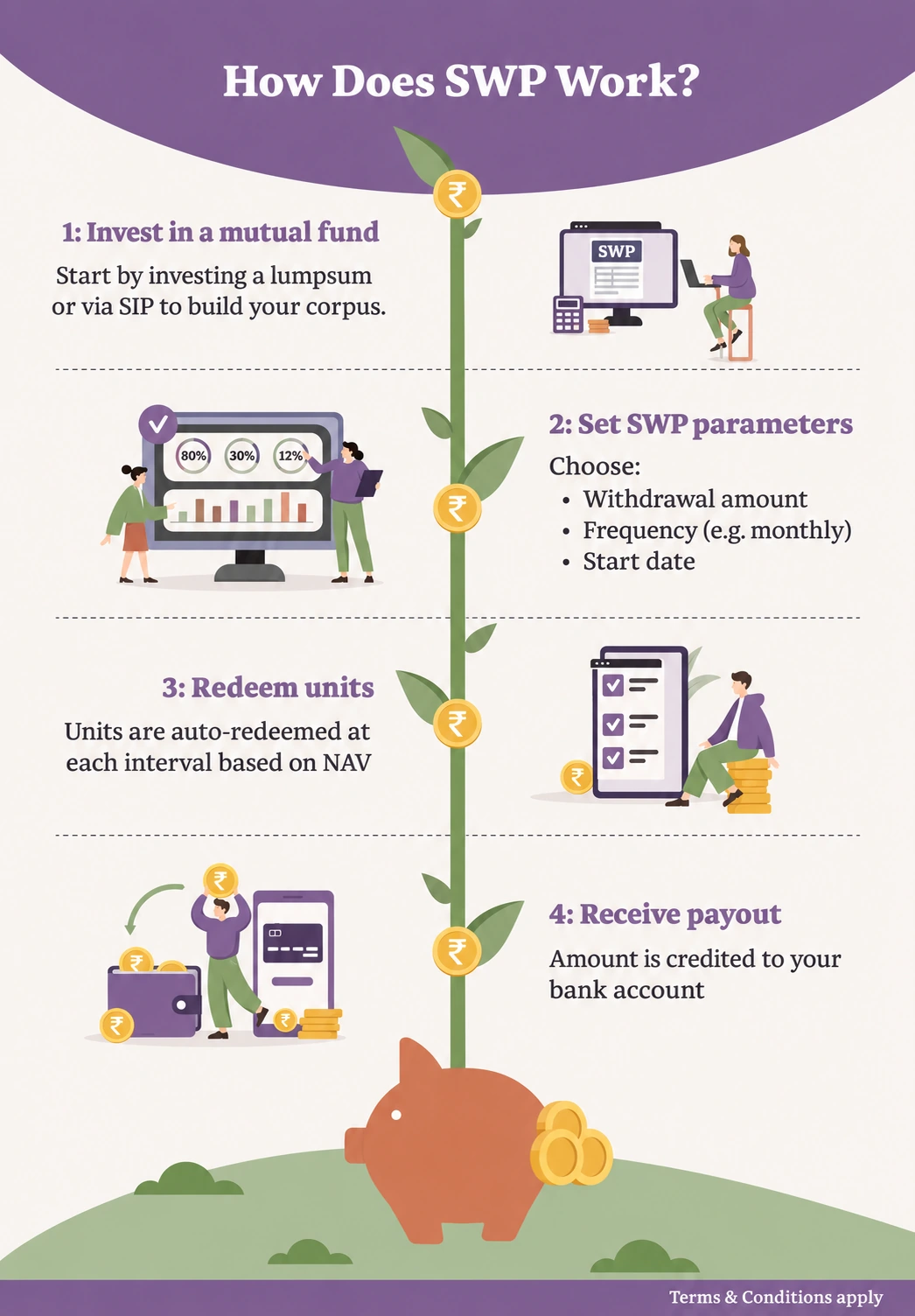
A Systematic Withdrawal Plan (SWP) allows you to invest a lump sum in a mutual fund and withdraw a predetermined amount at regular intervals. This can turn an accumulated investment corpus into a regular cash flow and may be useful for retirees or investors who want to use their investments to meet recurring expenses.
However, an SWP should not be treated as interest or guaranteed income. Each withdrawal involves redeeming mutual fund units, so the amount you receive can include both your investment and any gains on it. The underlying mutual fund remains market-linked, which means the value of the corpus can rise or fall.

An SWP is relatively easy to set up and offers high liquidity compared with assets such as property. The withdrawal schedule can also be predictable, but that does not mean the corpus will last indefinitely. Large withdrawals, poor market performance or a prolonged downturn can cause the corpus to decline faster than expected.
Capital required: Moderate to high
Ongoing effort: Low
Risk: Depends on the underlying mutual fund
Liquidity: High
Cash-flow predictability: The scheduled withdrawal is predictable, but the investment’s value and the period for which the corpus will last are not guaranteed.
Reference: https://www.amfiindia.com/Themes/Theme1/downloads/InvestorsAwarenessProgrampresentation.pdf
Savings accounts, deposits and government small-savings schemes
Savings accounts, recurring deposits and government-backed small-savings schemes can help investors earn interest with relatively low risk. However, they do not all produce regular cash flow. Savings-account interest is generally credited periodically, recurring deposits commonly pay the accumulated amount at maturity, while schemes such as the Post Office Monthly Income Scheme and Senior Citizens’ Savings Scheme are specifically structured to make periodic interest payments.
The capital required and income potential vary considerably across these options. A savings account can be opened with a relatively small balance, while specific small-savings schemes have their own eligibility criteria, investment limits and tenure requirements. Interest rates on government small-savings schemes are notified periodically, so they may change when the applicable rates are revised.
The main advantage is simplicity and relatively predictable interest income. However, returns are generally modest, and some products may have restrictions on withdrawals or premature closure. Bank deposits also have different protections from government small-savings schemes, so investors should check the specific terms rather than treating every deposit as equally protected.
Capital required: Low to moderate
Ongoing effort: Very low
Risk: Low, depending on the product
Liquidity: High for savings accounts; varies for deposits and small-savings schemes
Cash-flow predictability: High
Digital products
E-books, templates, online courses, stock photography and certain software tools can be created once and sold repeatedly without producing a new product for every customer. This makes digital products one of the more practical online passive income ideas in India, particularly for people who already have a useful skill or specialised knowledge they can package into something others are willing to pay for.
However, the income is rarely passive from day one. The biggest effort often comes before the first sale by researching what people need, creating the product, setting up a way to sell it and getting it in front of potential customers. Marketing, customer support, bug fixes or content updates may also require ongoing work depending on the product.
The financial barrier to entry can be low compared with investments such as property, but the time investment can be substantial. Income is also difficult to predict initially and may remain inconsistent until the product develops a steady customer base or receives regular traffic.
Capital required: Low
Ongoing effort: Moderate after a high initial effort
Risk: Moderate, mainly business and demand risk
Liquidity: Not directly applicable; revenue depends on continuing customer demand
Cash-flow predictability: Low initially
Royalties and licensing
Royalties and licensing can create passive income when you own something that others are willing to pay to use. This could include a book, music, photographs, illustrations, software, a patent or other intellectual property. Depending on the agreement, you may earn a royalty when the work is sold, streamed, reproduced or licensed for use.
The financial capital required can be relatively low, but the upfront effort is often substantial. Creating something valuable, protecting your intellectual property, finding buyers or licensees and negotiating agreements can take considerable time. Once the work is established and licensed, however, the ongoing effort can be much lower.
The main challenge is predictability. Royalty income depends on how often the underlying work is purchased or used, and there is no guarantee that a creative or intellectual property asset will generate significant demand. Income can therefore be irregular, with some periods producing little or nothing and others generating larger payments.
Capital required: Low
Ongoing effort: Low after high upfront effort
Risk: High
Liquidity: Low to moderate
Cash-flow predictability: Low
Affiliate marketing and content
A blog, YouTube channel or social media presence can generate income through affiliate commissions, advertising or other forms of content monetisation. You earn a commission when someone makes a qualifying purchase through your affiliate link, while platforms and advertisers may pay creators based on factors such as views, clicks or ad impressions.
The biggest advantage is the relatively low financial barrier to entry. You can start with skills, knowledge and basic tools rather than a large amount of capital. The trade-off is time. Building an audience, creating useful content and attracting consistent traffic can take months or even years, and there is no guarantee that the effort will translate into significant income.
Older content can continue generating traffic and revenue after it is published, which gives this model a passive element. However, content often needs to be updated, promoted or supplemented with new material to remain relevant. Income can also fluctuate considerably based on traffic, audience behaviour, platform algorithms and advertiser or affiliate rates.
Capital required: Low
Ongoing effort: High
Risk: Moderate
Liquidity: High
Cash-flow predictability: Low
A business that requires limited day-to-day involvement
A business can generate relatively passive income when its day-to-day operations are handled by employees, a manager or an external service provider. Examples include vending machines, equipment rentals, franchises with hired management and small businesses where operational responsibilities are delegated.
However, this is usually one of the least passive options on the list, at least initially. Setting up the business can require substantial capital, planning and hands-on involvement. Even after operations are delegated, the owner may still need to monitor finances, review performance, manage key decisions and deal with unexpected problems.
Liquidity can also be poor because selling a business or its assets may take time. Income depends on the underlying business performance, so it can fluctuate significantly with demand, operating costs and competition. For someone with the right capital, experience and a reliable operating team, it can become a source of relatively hands-off income, but it should not be mistaken for a completely passive investment.
Capital required: High
Ongoing effort: Moderate
Risk: High
Liquidity: Low
Cash-flow predictability: Low to moderate
Passive income sources with investment vs without investment
Broadly speaking, options such as FDs, bonds, REITs, InvITs, dividend-paying stocks, rental property and mutual fund SWPs require you to put money into an asset or investment upfront. Generally, a larger investment can generate more income if the rate of return and other factors remain the same, but the amount of income is still influenced by the specific investment and its performance.
Digital products, affiliate marketing and royalties can be started with relatively little financial capital. However, they often require a significant investment of time, skill and effort before they generate meaningful income. In many cases, there is also a waiting period while you build an audience, create demand or establish the underlying asset.
Savings accounts and some other basic deposit products sit somewhere in between. They require financial capital to earn interest, but the amount needed to get started can be relatively small.
Neither approach is inherently better. Capital-based passive income sources can offer greater predictability, but they require savings or an existing investment corpus. Options that rely more on time and skills can be started with less money, but there is no guarantee that the effort will translate into income.
Which passive income sources require the least capital?
Savings accounts and other basic savings instruments can be started with relatively small amounts. REITs and InvITs can also have a low entry barrier compared with buying property or investing directly in infrastructure, particularly because listed trusts can be purchased through the stock market.
Content-based options such as affiliate marketing and digital products can require even less financial capital to get started. However, they typically demand a much larger investment of time and effort before they generate meaningful income.
REITs and InvITs are particularly interesting for investors who want exposure to commercial real estate or infrastructure without having to purchase or manage physical assets themselves. Their relatively low entry requirement makes these asset classes accessible to retail investors, although the units remain market-linked and their distributions are not guaranteed.
The key point is that low capital does not automatically mean low risk or low effort. A digital product may cost little money to create but take months of work to gain traction, while a REIT may require little ongoing effort but still expose you to market fluctuations.
Which passive income sources can generate regular cash flow?
Fixed deposits and coupon-paying bonds can offer relatively predictable payment schedules when held according to their terms. However, not every fixed-income security pays periodic interest, and selling a bond before maturity can produce a gain or loss. An SWP can also provide a regular withdrawal schedule, although the withdrawals come from redeeming mutual fund units rather than from a guaranteed income stream. The sustainability of the withdrawals therefore depends on the size and performance of the underlying corpus.
REITs and InvITs can provide periodic distributions, but the amount paid can vary depending on the cash flows generated by the underlying assets. Rental income can also be relatively regular when a property has a stable tenant, but vacancies, maintenance and other costs can interrupt or reduce the cash flow.
Dividend income, royalties, affiliate earnings and revenue from digital products tend to be less predictable. Payments may vary significantly from one period to another, making these options less suitable if your primary goal is a fixed monthly cash flow. If predictable monthly income is important to you, the frequency and reliability of the cash flow matter just as much as the potential return.
How much money do you need to start building passive income?
There is no single amount you need to start building passive income. What matters is the type of income source you choose and how much capital or effort it requires. A relatively small amount can be enough to get started with products such as recurring deposits, listed REITs or InvITs, and some small-savings schemes, although minimum investment requirements vary.
The amount needed to generate meaningful monthly cash flow is a different question. Dividend stocks and mutual fund SWPs generally require a larger investment corpus if you want the income to cover a significant part of your expenses, because the amount you can withdraw or receive depends on the size and performance of the underlying investment. Rental property typically requires much more capital than financial investments and may also involve borrowing through a home or property loan.
If you're starting with limited savings, it can make more sense to focus on building the corpus first through regular saving and investing rather than waiting until you have a “large enough” amount to begin. Even a small SIP or recurring investment can help build the investment corpus that may later support withdrawals or other income-generating investments. A SIP itself does not produce guaranteed passive income.
How to choose the right passive income source
A few questions are more useful here than a generic checklist. How much capital can you commit without dipping into your emergency fund? How much time can you realistically give the option, particularly during the setup phase? How much volatility can you tolerate if the income or value of the asset fluctuates? How soon might you need access to the money? And are you looking for steady cash flow today, or are you primarily trying to build long-term wealth with income as a secondary benefit?
Your answers can help narrow down which passive income sources in India are worth considering. Someone who values predictable returns and may need access to their money sooner could prefer deposits or certain fixed-income products. Someone with a longer time horizon and a higher tolerance for market fluctuations may be comfortable with market-linked options.
You also don't necessarily have to rely on a single source. Combining different types of income-generating assets can help spread risk and balance different objectives. For example, you might combine relatively predictable fixed-income investments with market-linked assets offering greater long-term growth potential.
The right combination ultimately depends on your financial goals, existing investments, time horizon and ability to take risk.
How to start building passive income in India
- Build or confirm your emergency fund first: Investments that carry market risk should not be used as a substitute for cash that you may need at short notice.
- Choose one or two income sources that suit your situation: Consider your available capital, time and risk tolerance before choosing an option, rather than trying to invest in every source of passive income.
- Automate your investments where possible: Recurring deposits and SIPs can make regular investing easier, while an SWP can help automate withdrawals once you have built a suitable investment corpus.
- Understand the product before investing: Look at the risks, costs, liquidity, taxation and expected cash-flow pattern instead of choosing an investment based solely on its advertised returns.
- Review your strategy periodically: Your income, available capital, financial goals and risk tolerance can change over time, so an approach that works for you today may not remain suitable in the long run.
Passive income vs wealth creation
Passive income and wealth creation are related, but they serve different goals. Passive income focuses on generating regular cash flow through interest, dividends or rent, while wealth creation focuses on growing your underlying capital over time.
The two can sometimes involve a trade-off. Money paid out as income is no longer compounding unless you reinvest it. For example, growth-oriented mutual funds may focus on increasing your corpus rather than providing regular payouts, while FDs can offer more predictable interest income.
For long-term goals such as retirement, education or a home purchase, building the corpus may be the priority in the early years. As the need for regular cash flow approaches, you can consider adding more income-generating investments to your portfolio.
Tax on passive income in India
There is no single “passive income tax rate” in India. Tax treatment depends on the type of income and the applicable tax rules.
Interest, dividends, capital gains, rental income, and distributions from REITs or InvITs can all be taxed differently. Your applicable tax rate may also depend on factors such as your income, holding period and the nature of the investment.
Before investing, check the latest rules on the Income Tax Department or SEBI websites rather than assuming that all passive income is taxed at the same rate.
Common passive income mistakes to avoid
- Treating “passive” as “risk-free.” Every income source carries some form of risk, whether market, credit, liquidity or execution risk.
- Underestimating the effort involved. Rental properties, businesses and content-based income can all require ongoing work.
- Chasing unusually high returns. Understand where the return comes from and check whether the investment is regulated before committing your money.
- Ignoring liquidity. Putting too much of your savings into illiquid assets can leave you without accessible cash when you need it.
- Comparing returns before tax. Two investments with the same headline return can leave you with very different post-tax outcomes.
- Depending on one income source. Using different sources can reduce your reliance on any single investment or business performing well.
Frequently asked questions on passive income sources in India
What are the best passive income sources in India?
There is no single best option. It depends on your capital, the time you can give, your risk tolerance and how soon you may need the money. Options include fixed deposits, bonds, REITs, InvITs, mutual fund SWPs, rental property and content or digital products, and each trades off capital, effort, risk, liquidity and cash-flow predictability differently.
Can you earn passive income in India without investment?
Some options need very little money, such as digital products, royalties and affiliate content, but they usually need a lot of time, skill and effort before they earn meaningfully, and there is no guarantee they will. Low capital does not mean low risk or low effort. Most other passive income sources need some capital to start, though the amount varies by option.
Which passive income sources can generate regular cash flow?
Fixed deposits and coupon-paying bonds can offer relatively predictable payments when held as per their terms, and an SWP gives a scheduled withdrawal by redeeming mutual fund units. REITs, InvITs and rental property can also pay regularly, but the amount can vary. Dividends, royalties, affiliate earnings and digital product revenue are less predictable, so they suit a fixed monthly need less well.
How much money do you need to start building passive income?
There is no single amount. Recurring deposits, listed REITs or InvITs and some small-savings schemes can start with a small sum, although minimum investment requirements vary. Generating meaningful monthly cash flow from dividend stocks, SWPs or rental property needs a much larger corpus. If you have limited savings, it can make sense to build the corpus first through regular saving and investing.
How much can you earn from passive income per month?
There is no fixed amount that applies to everyone. What you earn depends on the capital you put in, the interest, rent, dividends or distributions the asset pays and the costs involved, and on market conditions for market-linked options. Fixed deposits and bonds are more predictable, while royalties, dividends, affiliate and digital product income can vary a lot from one period to the next.
How is passive income taxed in India?
There is no single passive income tax rate in India. Interest, dividends, capital gains, rental income and distributions from REITs or InvITs can all be taxed differently, and your applicable rate can also depend on your income, the holding period and the nature of the investment. Since tax rules can change, check the latest rules on the Income Tax Department or SEBI websites, or consult a qualified tax professional, before investing.
Disclaimer: This article is for educational purposes only and does not constitute investment advice. Investments in securities markets are subject to market risks; read all related documents carefully before investing.